Tuesday, October 18, 2016

Recent Rains, Divots, and Alphabet Soup!

Hello and welcome to "The Greenkeeper"!  Today is Tuesday, October 18th and Fall Member-Guest week is upon us.  But before we kick off the festivities beginning Thursday and concluding with the Shootout on Saturday afternoon, I would like to recap several events that have taken place the past three weeks.  Seems like just yesterday conditions were very dry and our irrigation reservoir was fast approaching a deficit equal to last year.  In fact on September 25th we were approximately 10 feet below full pond, basically the same level at this time last year.  Today the lake sits approximately 1 foot below capacity thanks to 9.5 inches rain that fell between September 26th and October 8th. During that two-week stretch the golf course endured a flash flood event, followed by several other heavy rains, then capped with an all day rain courtesy of Hurricane Matthew (no relation).  

Believe me when I tell you it is bittersweet to report the rainfall associated with Hurricane Matthew was helpful when so many North Carolina residents east of I95 are encountering flood levels not seen since the aftermath of Hurricane Floyd in 1999.  My heart goes out to those folks and to my fellow golf course superintendents along the Georgia and South Carolina coasts dealing with massive tree and debris cleanup.  Mother Nature is am imposing force that never ceases to amaze.

Recently I placed some new signage at the Driving Range Tee.  Hopefully you have seen it, and more importantly attempted to follow its message.  The purpose of the signs (there are two of them) is to help guide everyone during their practice sessions so that usable turf is maximized.  The sign below depicts a typical "scattered" divot pattern  in the lower right while the lower left depicts "strips".  

For the past few years I have tried to convey the importance of this message CLICK HERE because quite simply, despite possessing just over one acre of driving range tee space, it is not enough turf to accommodate everyone throughout the year.  By learning to take divots via this method less turf is consumed leaving more for the the next person, or better yet, next day.  
I bring this to your attention again now because we are just three weeks away from entering our off-season and our range policies this year will differ slightly from last.  Last year you recall we overseeded the entire primary range tee (upper and lower tiers) then renovated the teeing area this summer via Fraze mowing.  This year the Committee decided to overseed the lower tier only, and be open Fridays-Sundays (weather permitting).  Tuesdays-Thursdays the artificial mats will be used. The upper tier of the primary range tee and back range tee will be closed all winter to preserve and protect the turf through the winter season.  It's important everyone hitting balls on the lower tier this winter try their very best to follow this guideline, otherwise the turf will be consumed too quickly and we will be required to utilize the mats every day of the week until next spring.

In other news, the last two days of September were spent meeting with the USGA as we begin preparations for our role in the 2018 US Mid-Amateur Championship.  Hopefully you recall Carolina Golf Club will serve as the Stroke Play Co-host as Charlotte Country Club hosts the 2018 tournament CLICK HERE, now just a little over 700 days away.  On September 29th we met at Charlotte Country Club to review the Hosting Manual, a 104 page document that covers everything imaginable and then some.  The next day Bill McCarthy, Director US Mid-Am Championship spent the entire morning touring Carolina Golf Club.  We went through the entire course hole-by-hole from teeing ground, to landing zone, to green complex.  Mr. McCarthy was very complimentary of the golf course, especially the putting green complexes.  He made several suggestions to our current mowing patterns and presented them a few days later in a 10 page document using images from Google Earth.  Basically the requests are bringing in the fairway a few feet here and there on some holes while expanding the closely mowed area surrounding the greens on others.  

I met with the Greens Committee two weeks ago where we reviewed Mr. McCarthy's course prep memo.  We discussed each of the proposed changes and what impact, if any, these tweaks and adjustments would have on the membership.  It's impossible to know until we try so for now the plan is to implement these mowing pattern alterations next spring as the bermudagrass is breaking winter dormancy, then the USGA will return next fall to review and we will go from there.

And finally, in more alphabet related news.  The GCSAA has 98 affiliated chapters of which the Carolinas GCSA is one.  As a member of the Carolinas GCSA Board of Directors I was asked to serve as Chapter Delegate this year and proudly accepted the honor.  Last week was the annual Chapter Delegates meeting in Kansas where each affiliated chapter sends one delegate to meet with the national Board of Directors, association executives and staff to discuss the important issues facing our industry.  PRESS RELEASE   
It was definitely an eye opening experience to peek "behind the curtains" of our national association, now celebrating it's 90th year (CLICK HERE).  

Well, time to get back on the course and polish things up before our guests arrive.  Fall truly is the best time of year for golf at Carolina Golf Club as evident by the colors and contrasts depicted in the photos I tweeted below!

See you on the course,


Matthew Wharton, CGCS, MG

Thursday, September 22, 2016

Aeration Recap, Fall Golf, & the Ryder Cup!

Hello and welcome to "The Greenkeeper"!  Today is Thursday, September 22nd and the autumnal equinox occurred earlier today at precisely 10:21 am EDT.  That means Fall is officially here!  Of course we all know meteorological summer ended back on August 31st, greens aeration was September 6th and 7th, the NFL football season began on September 8th, and we removed the last two Turf Breeze fans from the golf course on Tuesday so I guess summer really is over!  Hallelujah!

It's hard to believe it's been just over three weeks since my last update.  I mentioned above greens aeration already took place and if you were following along on Twitter you not only saw the team in action but have monitored the healing progress.  Before I share that information with you I want to point out this is the first year we have performed fall aeration this early.  Historically we waited until the third Monday in September to begin the operation, but last spring the Greens Committee asked if there would be any negative ramifications with aerating sooner.  I informed the group that was not the case, our schedule had always been determined by other factors and with those factors not in place this year the decision was made to aerate immediately after Labor Day.  And thank goodness we did when you consider this year produced the 2nd all time hottest summer in Charlotte.
The putting greens were definitely ready to catch their breath after the past few months, and from looking at the results I firmly believe we made the right decision.  We switched back to a traditional method of physically removing cores opposed to mechanical removal and continued with our old school approach of hand brooming the topdressing sand.  It's a very labor intensive process that requires a number of staff dedicated to the process working long hours, but the results are very rewarding.

With aeration in the books, and the greens finally healed we can now focus our attention on other important areas.  Of course the last tweet above references there are certain areas on some greens more stressed than others prior to aeration and we will begin making repairs to these areas next week with turf from the nursery green.  While closed for aeration we topdressed all tees and fairways.  This was the third time this season we applied 10 tons sand per acre to closely mowed turf this year.  The week immediately following aeration we made our final fertilizer application to all bermudagrass turf and currently we are making pre-emergent herbicide applications to prevent and manage poa annua and other winter weeds from invading our bermudagrass playing surfaces this coming dormant season.  If you notice random paint marks (orange or blue) on the course over the next few weeks, these are just points of reference identifying where we have treated the turf.  


When you are trying to uniformly apply product to approximately 100 acres it takes several trips back to the Turf Care Center to refill the tank.  Also, our primary pre-emergent herbicide is not labeled for use on or near the putting greens so we will come back to these areas with a different product that is registered and the paint helps ensure we do not have unnecessary skips or overlaps.  It's all in the name of environmental safety! 

Recently you may have also noticed a few areas where the turf has turned browned and been mowed down (between 4 & 17, between 5 & 15, right of 13 green).  These areas were targeted by me and the Committee for renovation as their composition had evolved and they were no longer performing to expectation.  We sprayed the existing undesirable grasses with non-selective herbicide and will be reseeding with our fine fescue mixture.  Fall really is a great time to catch your breath after the long, hot summer and perform other types of course work that really makes an impact.  
Hummocks Left of 17

Natural Area Right of 15
Between 13 Green & 18 Tee


Fall also signals the arrival of cooler temperatures, firmer conditions, transitional color, and faster greens.  I believe everyone is ready to enjoy some fall golf and with events like Guest Day, Fall Member-Guest, Tough Day, and the Carolina Invitational just around the corner nothing could be finer than fall golf at Carolina.

And speaking of events just around the corner, next week what I believe to be the greatest event in all of sports will take place, the Ryder Cup.  I truly believe this event has grown into something so different and special, and it never ceases to amaze me how certain players elevate the level of their play for this event.  The matches return to home soil for the first time since 2012 and will be contested at Hazeltine National Golf Club in Chaska, MN.  


Golf Course Superintendent Chris Tritabaugh and his staff have been preparing for these matches since before the 2014 Ryder Cup was held at Gleneagles.  Chris can be found on Twitter @ct_turf where he has an amazing following.  For several years now Chris has been sharing with us an up close, behind the scenes look at all the preparations required to host what some will say is the "Super Bowl of Golf".  I strongly encourage you to give Chris a follow and gain access to inside information on course preparations for the upcoming matches.  And if you're a real die-hard, follow Steve Chappell @CentenaryHGK.  Steve is Head Greenkeeper of the PGA Centenary Course at The Gleneagles Hotel, site of the 2014 Ryder Cup.  Steve headlines an impressive list of superintendents and industry professionals from around the globe that have traveled to Hazeltine to assist Chris and his team produce the highest quality playing conditions for this amazing competition.  It really is inspiring to witness all the hard work and attention to detail.  I wish Chris, his team, and all the volunteers all the best... and of course, Go Team USA!

See you on the course,

Matthew Wharton, CGCS, MG

Wednesday, August 31, 2016

Abuse, Wx Brad, and Goodbye to Summer!

Hello and welcome to "The Greenkeeper"!  Today is Wednesday, August 31st and I'm very happy this day has arrived.  Today marks the end of meteorological summer (Jun-Aug) and the summer of 2016 definitely was one for the record books.  If you recall the last time we were here, I shared some information with you regarding July's warmth, how humid this summer was compared to last year, and about how those environmental stresses impact our putting green health and performance.  Now that we are ready to officially close the curtain on summer 2K16 I have some updated information on where this summer ranks with others and what I propose we do to regain the upper hand before next year.

But before I do that I must share something disturbing with you.  This past Sunday someone decided to hit a golf ball from off the 11th green.  This is a very uncharacteristic act and I do not know who did it, but I do know the Golf Staff has been working diligently to help uncover the mystery.  

Divot
Crime Scene


We discovered the damage early Monday morning with the divot still lying in the bunker (they didn't even think to replace their divot).  I think the most troubling aspect is the evidence clearly shows this was done purposely as opposed to it being an accident.  How do I know this?  Rarely, but on occasion someone might miss a short putt and attempt to knock their ball away from the hole with their putter and inadvertently make contact with the putting green damaging the surface.  In this instance the divot is not located anywhere near the hole location as the hole was cut nearly in the center of the green Sunday, and the direction of the swing and resulting resting place of the displaced divot indicates this person was walking off the green and decided to stop and take a swing at a ball.  Inexcusable.  To make matters worse we found another divot taken from the same green yesterday afternoon.
Different Divot
Located Near Front of Green


A different divot made at a different time but also located on the 11th green.  Thank goodness we are less than a week away from aeration so these greens can recover from this abuse.

Now back over to Brad Panovich for an update on this summer's weather!
As you can see from the chart above, the summer of 2016 ranked as the second hottest summer all-time in the city of Charlotte finishing just above the infamous summer of 2010 (more on this later). You will also notice the summers of 2011 and 2015 occupying the top 10 meaning we've endured a few memorable ones recently.  But more importantly than just warm temperatures alone, we tied a record this summer for the most consecutive days with nighttime low temperatures above 70 F.  
For 30 consecutive mornings the temperature never dropped below 70 F and the majority of that streak saw the temperature well above that mark.  One thing interesting to note regarding this record is the summers of 2010, 2011, and 2015 do not appear in this top 10 list meaning despite those hot years we never came this close to enduring a stretch like experienced this year.  

Now why are nighttime temperatures so important you ask.  One of the first things they teach you in turf school is the power of the number 160.  When daytime highs (90's) and nighttime lows (70's) combine to total 160 or above it means you've reached environmental conditions highly conducive for cool-season turf decline.  In fact there is an entire book dedicated to the subject of summer bentgrass decline.


What's interesting is the first page of the book references how creeping bentgrass declines in summer months and it can be very difficult to establish the exact cause due to the complex interrelationships of the many factors that contribute to the decline complex.

So let's review what we do know.  The summer of 2015 (last year) was very hot and our greens exceeded expectations.  I recall multiple conversations held with the Greens Committee last season where everyone expressed how pleased they were with the overall health and performance of the putting greens.  Last summer was very dry (5.92 inches rain Jun-Aug combined) and with us in control of the water we were able to survive a top 5 scorcher.  

The summer of 2016 was hotter than last year (refer again to chart above) and drier than last year from a rainfall perspective (only 5.49 inches rain Jun-Aug combined this year).  But the humidity levels experienced this summer for prolonged periods during the last two months made all the difference.  We encountered some disease pressure and general thinning of the turf canopy.


I will say if there is one positive of thinning turf, it's how it highlights the importance of aeration.  Notice how the spring aeration pattern is revealed where the stronger plants survive the environmental stress.

As I referenced last time, fans modify the micro-climate and allow the turf to cool itself, permitting the plants metabolic processes to function normally.  In the summer of 2010 we quickly learned the micro-climates of putting greens located along the perimeter of the property were compromised versus those within the interior of the golf course, and five new fans were installed that summer (bringing our total to 8).


Existing Fan Placement
The fans located at holes 12 and 16 were installed during the grow-in of the restoration in 2008 and the fan located at hole 1 was installed in May of 2010 (before the you-know-what hit the fan) pun intended.  Holes 7, 8, 11, 13, and 14 were added later that same year as a result of severe turf decline.  

If we take a closer look at this aerial view we can identify three more putting greens located on the boundary, Hole 9, the Putting Green (PG), and the Chipping Green (CG) and two of those three definitely encountered some thinning this summer (9 & PG).  One other green that struggles in severe summers is Hole 2.  You wouldn't expect the micro-climate of this green to be compromised when viewed from above but this green would certainly improve its performance with a fan. 


Future Proposed Fan Placement
I think it's safe to say the summer of 2016 revealed the areas where we can most improve our defenses in order to provide even better playing conditions for you and your guests.  Not every summer will be as hot or muggy as this one, but when the next one comes along I want your greens and your course to be ready.  

And speaking of the importance of aeration, remember upon the conclusion of the Club Championship this holiday weekend we will be closed both Tuesday and Wednesday (September 6th and 7th) for putting green aeration.  We will aerate with 1/2 inch tines on a tight spacing designed to impact approximately 10 percent of the surface area.  We will remove the cores and topdress heavily with sand.  To learn more why courses aerate and the benefits of aeration CLICK HERE to read a brief PSA courtesy of the USGA.  That's all for now...

See you on the course,

Matthew Wharton, CGCS, MG

Friday, August 12, 2016

Outbreak, Back Side of Summer, Championships, and Ball Marks!

Hello and welcome to "The Greenkeeper"!  Today is Friday, August 12th and I'm happy to report it appears we are on the verge of surviving another very challenging summer.  My apologies for taking so much time between this post and my last, but my staff and I have had our hands full since the conclusion of Independence Day.  I'm going to share with you some information that will put everything you currently see on the golf course in greater context and talk about a few things right around the corner, so let's go.

Since August's arrival the golf course has received 1.63 inches rain.  That is more than we received the entire month of July when only 1.44 inches fell on Carolina Golf Club.  More importantly, this most recent week filled with periods of showers (some heavy at times) has been mostly cloudy brought upon by the constant flow of moisture from the south fueling the rain events.  Although cloudy conditions can disrupt the photosynthetic processes of plants, the clouds have helped to trim temperatures significantly from the mid and upper 90's we endured the last week of July.  Also, the rain has given our pump station several nights rest which is always a good thing this time of year.

This brief period of "relief" has helped our bentgrass putting surfaces "catch their breath" if you will while the moist, humid conditions have helped create the thickest, densest, most uniform rough Carolina Golf Club has ever seen.  The golf course definitely has some teeth right now if you stray from the fairway.  But back to the greens "catching their breath".  Although still very humid and uncomfortable, the decline in temperatures has slightly reduced the stress the plants were under and we've seen more recovery in our summer blemishes (AKA "battle scars").

Two days ago I was having a brief phone conversation with a former classmate of mine, Sean Baskette.  Sean is the golf course superintendent of Hidden Valley C.C. in Salem, VA and we were comparing notes on how summer has treated our respective golf courses.  They have endured way more rain in Virginia than we have, but temperatures and dew point levels are mostly comparable.  It was funny that we both agreed June was virtually uneventful.  Neither of us could recall anything about the first month of summer that really stood out from a turf care perspective.  

I recall examining the overall quality of our putting greens on Friday, July 1st and thinking to myself the greens were in excellent condition.  One week later I was telling Assistant Superintendent Ben Albrecht to meet me the following morning at 4:30 am so we could make a fungicide application to stop the spread of a turfgrass disease outbreak.  The fungus responsible lives in the soil and we routinely make preventative applications in order to keep the disease from expressing itself, but one thing you quickly learn in this business is Mother Nature is always in control, no matter the best of plans.  When the environmental conditions favorable for disease development are at their peak, sometimes there isn't anything you can do.

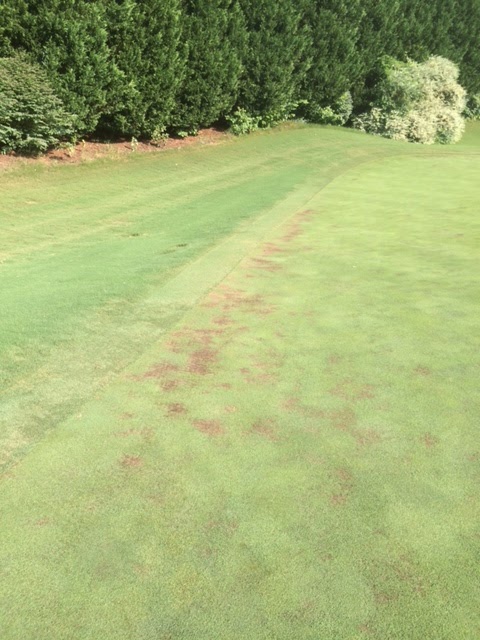
We encountered an outbreak of Pythium Root Rot (I know, it sounds terrible) for the first time since 2012.  Turns out this PRR outbreak was widespread throughout the Carolinas and mid-Atlantic and brought on by untimely rains in conjunction with high dew points (humidity).  Here at Carolina Golf Club we received rainfall on the afternoons of July 5th, 7th, and 8th.  These three rain events totaled exactly 0.34" meaning our greens remained wet in the upper portion of the soil profile (where the fungus resides) for too lengthy a period.  
PRR on Putting Green
Notice Dense Wall of Vegetation Nearby

Our quick actions and emergency recovery application the morning of July 9 worked to stop the spread of the disease and the greens have been getting better ever since.   Despite the unsightly appearance of lingering blemishes, the crowns of the plants are alive and will generate new leaves when more favorable weather for bentgrass returns to our region.  However, although we stopped the fungus in its tracks overall plant recovery has been slowed due to the extreme heat and humidity that has gripped our region the past several weeks following the outbreak.  

Just recently it was released that July 2016 ended up as the third hottest July ever in Charlotte.  The hottest was in 1993 and the second hottest in 1986 which means not only was July 2016 very uncomfortable, but it was the hottest July experienced in the Queen City in 23 years!  However, there is an old adage that says, "It ain't the heat, it's the humidity!" and I cannot express to you how true that is when it comes to the health and performance of your bentgrass putting greens. 

I can tell you it's been at least 4 or 5 years since we have endured humid conditions such as we are currently experiencing.  There is a reason why certain greens have a fan placed nearby and it is not a coincidence those greens are in better health than several without fans.  Bentgrass is a cool-season turf and the plant must fight for survival during the most extreme of conditions.  Air movement is critical to overall turf health because stagnant, humid air over the plant canopy prevents the plant from cooling itself.  Just like perspiration remains on your skin making you uncomfortable on humid days, the turf is attempting to cool itself by releasing moisture through leaf openings call stomata. When a humid air mass hovers over the plant canopy that moisture released through the leaf openings cannot evaporate and the turf becomes very uncomfortable to say the least.  Fans clear the humid air mass out of the way allowing the plant to function normally.

No. 1 with fan

No. 8 with fan

No. 13 with fan


No. 15 (No Fan)


But don't let all this talk about turf diseases and unfavorable weather patterns alarm you.  Last week I asked Dr. Jim Kerns, Turfgrass Pathologist of N.C. State University to stop by and have a look.  He was in the area visiting several courses and was kind enough to stop by and visit with me and members of my team (Assistant Superintendent, Ben Albrecht and Intern, Jeremy Smith pictured below).  We took real close looks at several greens, talked about the symptoms and climatic conditions experienced this season, and our nutrition and fungicide programs.  


Dr. Jim Kerns

Talking Turf With Staff


In all Dr. Kerns was impressed with the overall condition of our putting surfaces (except for the recent ball mark epidemic) and expressed we were in far greater shape than others.  Several courses in our region have been forced to close for brief periods due to the extreme conditions experienced this summer.  He encouraged us to continue trusting our instincts and keep doing what we've been doing (try to keep them as dry as possible without getting too dry; difficult challenge in such humid conditions).  And there is good news on the horizon.  Yesterday marked the "official" end to the Dog Days of Summer despite this morning's oppressive humid conditions, and the laws of physics are in our favor.  I mean, the calendar may still say August but the days are already getting shorter.  Shorter days means longer nights and longer nights means there is a greater possibility for temperatures to drop to levels more conducive for our turf.  You see, when you wake up at 4:00 am to find the temperature outside is still somewhere between 76 to 82 degrees you know the bentgrass is not happy.  When nighttime temperatures remain elevated, the greens are not able to fully recover from the stress of the day before reentering the next stressful daytime period.  In other words, think of it like this, how refreshed and energetic would you feel if you slept through the night with a pillow held over your face.  Probably not too good. So take solace in knowing relief is just around the corner.

In other news, this year will mark the first time Carolina Golf Club has hosted a competitive round of the Charlotte City Amateur since 2013, but more importantly this year we host the final round of the 2016 championship.  It is exciting to have the opportunity to showcase your golf course for the best players in the Queen City.  This year's Charlotte City Amateur is August 19-21 with round 1 at Providence C.C., round 2 at Myers Park C.C., and round 3 here at Carolina on Sunday, August 21st!  

Shortly after the city championship it will be time to focus our attention on the Club Championship contested this year September 3-5.  Immediately following this year's tournament we will close for two days (Tuesday and Wednesday, September 6-7) for putting green aeration.  During that same time we will topdress all fairways and approaches with an additional 300 tons of sand.

Finally, I inserted a comment earlier regarding ball marks.  This coming Sunday, August 14 is National Repair Your Pitchmark Day in the U.K.  I've tried to help support this cause the past couple of years via social media and as I've always said, "everyday should be national repair your pitchmark day." Here is a really cool video just released by the good folks at Golf Channel that helps explain the little things you (the golfer) can do to help make your course better.  It features former Carolina member Gary Williams and former Fort Mill, SC resident Charlie Rymer so in some ways you might think of this PSA as home grown.  The entire video is full of great information but please pay attention to the 3:12 mark as Charlie demonstrates the proper method required to repair a ball mark.

See you on the course,

Matthew Wharton, CGCS, MG