Friday, August 12, 2016

Outbreak, Back Side of Summer, Championships, and Ball Marks!

Hello and welcome to "The Greenkeeper"!  Today is Friday, August 12th and I'm happy to report it appears we are on the verge of surviving another very challenging summer.  My apologies for taking so much time between this post and my last, but my staff and I have had our hands full since the conclusion of Independence Day.  I'm going to share with you some information that will put everything you currently see on the golf course in greater context and talk about a few things right around the corner, so let's go.

Since August's arrival the golf course has received 1.63 inches rain.  That is more than we received the entire month of July when only 1.44 inches fell on Carolina Golf Club.  More importantly, this most recent week filled with periods of showers (some heavy at times) has been mostly cloudy brought upon by the constant flow of moisture from the south fueling the rain events.  Although cloudy conditions can disrupt the photosynthetic processes of plants, the clouds have helped to trim temperatures significantly from the mid and upper 90's we endured the last week of July.  Also, the rain has given our pump station several nights rest which is always a good thing this time of year.

This brief period of "relief" has helped our bentgrass putting surfaces "catch their breath" if you will while the moist, humid conditions have helped create the thickest, densest, most uniform rough Carolina Golf Club has ever seen.  The golf course definitely has some teeth right now if you stray from the fairway.  But back to the greens "catching their breath".  Although still very humid and uncomfortable, the decline in temperatures has slightly reduced the stress the plants were under and we've seen more recovery in our summer blemishes (AKA "battle scars").

Two days ago I was having a brief phone conversation with a former classmate of mine, Sean Baskette.  Sean is the golf course superintendent of Hidden Valley C.C. in Salem, VA and we were comparing notes on how summer has treated our respective golf courses.  They have endured way more rain in Virginia than we have, but temperatures and dew point levels are mostly comparable.  It was funny that we both agreed June was virtually uneventful.  Neither of us could recall anything about the first month of summer that really stood out from a turf care perspective.  

I recall examining the overall quality of our putting greens on Friday, July 1st and thinking to myself the greens were in excellent condition.  One week later I was telling Assistant Superintendent Ben Albrecht to meet me the following morning at 4:30 am so we could make a fungicide application to stop the spread of a turfgrass disease outbreak.  The fungus responsible lives in the soil and we routinely make preventative applications in order to keep the disease from expressing itself, but one thing you quickly learn in this business is Mother Nature is always in control, no matter the best of plans.  When the environmental conditions favorable for disease development are at their peak, sometimes there isn't anything you can do.

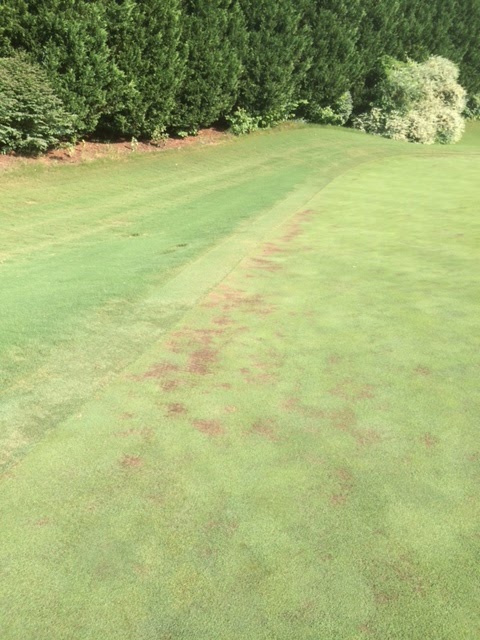
We encountered an outbreak of Pythium Root Rot (I know, it sounds terrible) for the first time since 2012.  Turns out this PRR outbreak was widespread throughout the Carolinas and mid-Atlantic and brought on by untimely rains in conjunction with high dew points (humidity).  Here at Carolina Golf Club we received rainfall on the afternoons of July 5th, 7th, and 8th.  These three rain events totaled exactly 0.34" meaning our greens remained wet in the upper portion of the soil profile (where the fungus resides) for too lengthy a period.  
PRR on Putting Green
Notice Dense Wall of Vegetation Nearby

Our quick actions and emergency recovery application the morning of July 9 worked to stop the spread of the disease and the greens have been getting better ever since.   Despite the unsightly appearance of lingering blemishes, the crowns of the plants are alive and will generate new leaves when more favorable weather for bentgrass returns to our region.  However, although we stopped the fungus in its tracks overall plant recovery has been slowed due to the extreme heat and humidity that has gripped our region the past several weeks following the outbreak.  

Just recently it was released that July 2016 ended up as the third hottest July ever in Charlotte.  The hottest was in 1993 and the second hottest in 1986 which means not only was July 2016 very uncomfortable, but it was the hottest July experienced in the Queen City in 23 years!  However, there is an old adage that says, "It ain't the heat, it's the humidity!" and I cannot express to you how true that is when it comes to the health and performance of your bentgrass putting greens. 

I can tell you it's been at least 4 or 5 years since we have endured humid conditions such as we are currently experiencing.  There is a reason why certain greens have a fan placed nearby and it is not a coincidence those greens are in better health than several without fans.  Bentgrass is a cool-season turf and the plant must fight for survival during the most extreme of conditions.  Air movement is critical to overall turf health because stagnant, humid air over the plant canopy prevents the plant from cooling itself.  Just like perspiration remains on your skin making you uncomfortable on humid days, the turf is attempting to cool itself by releasing moisture through leaf openings call stomata. When a humid air mass hovers over the plant canopy that moisture released through the leaf openings cannot evaporate and the turf becomes very uncomfortable to say the least.  Fans clear the humid air mass out of the way allowing the plant to function normally.

No. 1 with fan

No. 8 with fan

No. 13 with fan


No. 15 (No Fan)


But don't let all this talk about turf diseases and unfavorable weather patterns alarm you.  Last week I asked Dr. Jim Kerns, Turfgrass Pathologist of N.C. State University to stop by and have a look.  He was in the area visiting several courses and was kind enough to stop by and visit with me and members of my team (Assistant Superintendent, Ben Albrecht and Intern, Jeremy Smith pictured below).  We took real close looks at several greens, talked about the symptoms and climatic conditions experienced this season, and our nutrition and fungicide programs.  


Dr. Jim Kerns

Talking Turf With Staff


In all Dr. Kerns was impressed with the overall condition of our putting surfaces (except for the recent ball mark epidemic) and expressed we were in far greater shape than others.  Several courses in our region have been forced to close for brief periods due to the extreme conditions experienced this summer.  He encouraged us to continue trusting our instincts and keep doing what we've been doing (try to keep them as dry as possible without getting too dry; difficult challenge in such humid conditions).  And there is good news on the horizon.  Yesterday marked the "official" end to the Dog Days of Summer despite this morning's oppressive humid conditions, and the laws of physics are in our favor.  I mean, the calendar may still say August but the days are already getting shorter.  Shorter days means longer nights and longer nights means there is a greater possibility for temperatures to drop to levels more conducive for our turf.  You see, when you wake up at 4:00 am to find the temperature outside is still somewhere between 76 to 82 degrees you know the bentgrass is not happy.  When nighttime temperatures remain elevated, the greens are not able to fully recover from the stress of the day before reentering the next stressful daytime period.  In other words, think of it like this, how refreshed and energetic would you feel if you slept through the night with a pillow held over your face.  Probably not too good. So take solace in knowing relief is just around the corner.

In other news, this year will mark the first time Carolina Golf Club has hosted a competitive round of the Charlotte City Amateur since 2013, but more importantly this year we host the final round of the 2016 championship.  It is exciting to have the opportunity to showcase your golf course for the best players in the Queen City.  This year's Charlotte City Amateur is August 19-21 with round 1 at Providence C.C., round 2 at Myers Park C.C., and round 3 here at Carolina on Sunday, August 21st!  

Shortly after the city championship it will be time to focus our attention on the Club Championship contested this year September 3-5.  Immediately following this year's tournament we will close for two days (Tuesday and Wednesday, September 6-7) for putting green aeration.  During that same time we will topdress all fairways and approaches with an additional 300 tons of sand.

Finally, I inserted a comment earlier regarding ball marks.  This coming Sunday, August 14 is National Repair Your Pitchmark Day in the U.K.  I've tried to help support this cause the past couple of years via social media and as I've always said, "everyday should be national repair your pitchmark day." Here is a really cool video just released by the good folks at Golf Channel that helps explain the little things you (the golfer) can do to help make your course better.  It features former Carolina member Gary Williams and former Fort Mill, SC resident Charlie Rymer so in some ways you might think of this PSA as home grown.  The entire video is full of great information but please pay attention to the 3:12 mark as Charlie demonstrates the proper method required to repair a ball mark.

See you on the course,

Matthew Wharton, CGCS, MG

Thursday, July 14, 2016

Offense, Defense, and Royal Troon!

Hello and welcome to "The Greenkeeper"!  Today is Thursday, July 14th and the 145th Open Championship is underway at Royal Troon.  What an honor it must have been for Colin Montgomerie to hit the opening tee shot of this year's championship at the course that has meant so much to his family, not to mention the fact that now at age 53 he qualified for the event.  That's right, he successfully managed to advance through 36-hole qualifying in order to participate in this year's championship, that's a wonderful achievement.  


Anyway, we will make our way back to Royal Troon in a bit.  I want to talk with you first about our bentgrass putting greens and our management philosophy this time of year.  Second I will share with you a little more information about what we are currently doing in the natural/native areas and then I want to say a few words about saying goodbye to an old friend.

Bentgrass is a cool-season turf that performs quite well in our climate for approximately 9 to 10 months out of the year (September through May or June).  It's the remaining part of the calendar that can give professional turfgrass managers like me gray hair as we sometimes endure sleepless nights. Properly managing bentgrass through a transition zone summer has its challenges, but despite those challenges I still believe bentgrass produces a superior playing surface compared to alternative grasses, even in the summer.  Let me explain.

The other day I had an impromptu conversation with a member that inspired this post.  We talked about the putting surfaces and their overall quality for this time of year.  Things like surface smoothness, turf density, and yes, even putting speed.  The biggest knock against bentgrass in the summer is the inability to produce fast putting green speeds similar to experienced in the spring and fall.  First, you could produce faster green speeds but the grass would not survive for too long a period and then you would be left with no greens.  Second, if you stop and think about the playing surface from a different perspective I think you might be surprised.

Earlier I mentioned how the bentgrass thrives in our climate for about 9 months out of the year.  When the turf is growing in favorable conditions my staff and I manage the greens in an aggressive manner. In other words we play offense.  Our mowing heights are at their lowest and we use grooved rollers on our mowers to help achieve a tight cut.  We roll frequently to increase firmness and speed. Essentially everything we do is for the sake of producing high quality putting surfaces by today's standards (firm, smooth, and fast).  This is also why the club's golf calendar schedules all major events in the spring and fall.

In the stressful summer months we shift gears and play defense.  We raise the heights of cut and use smooth rollers on our mowers to protect sensitive leaf tissue.  We substitute rolling in place of mowing on some days when the temperature reaches extreme levels.  We vent more frequently to promote gas exchange.  Our moisture management is important year round but during these days it is critical in order to preserve and protect plant health.  The hot, humid conditions prevalent in our region this time of year elevates disease pressure requiring us to be extremely vigilant with our preventative fungicide programs.  Essentially everything we do is for the sake of plant health, because without healthy plants surviving the summer we will not be able to produce the quality surfaces you are accustomed to when fall temperatures return.

Here is where I think things get a little interesting.  When we play offense many of you play defense. Putting becomes more difficult and challenging because you are cautious and guarding against the possibility of the dreaded three-putt.  Rather than stroking putts with confidence and authority, you putt defensively.  Conversely, when we play defense you can play offense.  With smooth greens and slightly slower speeds you can putt more aggressively and freely at the hole without fear of running your first putt too far past.  In other words, you may actually hole more putts!  Although I've only managed to play one round here thus far this summer, I actually feel like I can shoot lower scores this time of year because I find the greens fun to putt.  I just embrace the slightly slower speeds because they actually remind me of what we will see on television this week as we watch The Open Championship.  I also heard a certain Committee Chairman recently made his way around the course in 62 strokes (Par 71), thus I'm quite sure he holed several putts. :)

Now, there are many more factors that affect putting green speed than just simply the height of cut. Moisture is definitely one of the biggest as humidity is a speed killer.  There is also sun, shade, wind, heat, cold, leaf wetness, soil moisture, soil firmness, and more.  The golf course is a living, breathing thing and all the elements of nature impact the way the course will play daily.  Here is an interesting link to a recent Course Care posting from the USGA Green Section regarding the factors affecting putting green speeds.  CLICK HERE

Last blog post I referenced how the staff had been working diligently to remove unwanted weeds from our cool-season (fescue) natural/native areas, but we needed to mow our warm-season (broomsedge, bluestem) areas to help restore order.  Despite a major holiday and a few afternoon thunderstorms containing high winds that deposited debris across the course and brought down a few trees, the staff has managed to complete the selective mowing.  We have also applied selective herbicide to these mowed areas to fully remove any unwanted plant material in order to allow the desirable warm-season grasses to flush out without competition.  The broomsedge, blue stem, and grammas will quickly bounce back and produce a seed stalk later this summer which will turn color in early fall enhancing the aesthetics of the golf course.  My team has also continued to make great progress in those fescue areas that are continuing to perform to expectations despite the current high temperatures. 


Broomsedge Area Mowed Behind 13 Green

Broomsedge Area Mowed and Sprayed

Fescues Near 14 Tee


Fescues Above 16 Green


And finally, this past Monday saw the removal of the large White Oak that stood guard near our nursery green (left of the path near No. 5 green).  You may recall last year we had to selectively remove some dead wood in the upper canopy.  This spring the tree again did not leaf out completely resulting in more dead wood and additional decaying wood.  Our consulting arborists from Arborguard performed multiple consultations and even a climbing inspection.  After reviewing the report the Committee did not hesistate to put first the safety of our members and guests and voted to remove the tree.
That area between the tree and nursery green has always been one of my favorite spots as I have taken and shared numerous pictures from that vantage point.  Superintendents and Course Managers sometimes get a bad rap for hating trees and/or wanting to remove all trees, but not all trees are bad and I will have nothing but fond memories of that tree.

One more thing, we will begin round 2 of fairway topdressing the week of July 25th.  During that time we will also aerate tees and collars.  That's all for now.  It's time to check on the leader board and see how things are going at Royal Troon. Billy McLachlan, Course Manager at Royal Troon is working his fifth Open Championship on those links.  He joined the greenkeeping staff there in 1981 and ascended to top rank in 1994.  I have it on good authority the greens are rolling about 10 feet on the Stimp meter for this championship.  A far cry from the speeds associated with the most recent major championship played, but in my opinion way better.  Enjoy The Open! 

See you on the course,

Matthew Wharton, CGCS, MG

Tuesday, June 28, 2016

Cultural Practices, Oakmont, the USGA, and Nature!

Hello and welcome to "The Greenkeeper"!  Today is Tuesday, June 28th and I want to recap what's been transpiring on the golf course lately, tell you a little about my trip to the US Open, and then share something neat with you.  I will also make you aware of what to expect on the course over the coming days as we are about to close the book on June with July only 3 days away!  

When we last gathered here we were in the middle of putting green aeration.  This is a small, hollow tine aeration that serves to bridge the gap between our March and September aerations.  Our climate in conjunction with our busy golf schedule in late spring makes it impossible for the greens to survive the entire summer without this breather (see what I did there).  You see oxygen is vital for root survival and our small tine aeration immediately following Memorial Day helps provide oxygen to the root zone before the greens enter the heat of battle (I did it again).

Last week we core aerated and topdressed all tees.  Fairways, approaches, and surrounds were topdressed with sand and then aerated using solid tines.  Now you may be asking why are we not removing a core on the fairways when we do so on greens and tees.  Remember the greens and tees are constructed from sand while the remainder of the course is composed of Piedmont red clay.  A couple of years ago the decision was made to implement a fairway topdressing program in an effort over time to establish a sand cap on our fairways to improve drainage as well as fairway firmness and smoothness.  
First Pass On No. 8


Almost Finished

Slow and Steady


In order to establish the sand cap it is necessary to avoid pulling clay soil to the surface and incorporating into the canopy like we did years before.  Another benefit of this process is we avoid the muddy tire tracks and muddy foot prints on the greens and clubhouse carpets, and more.  Last year we topdressed the fairways twice (July and August).  This year we have targeted three applications during the summer bermudagrass growing season.

Just prior to the week of fairway topdressing and aeration I had the good fortune to attend this year's US Open at Oakmont Country Club for two days.  I had never been to Oakmont before so it was a real treat to see firsthand all the work accomplished restoring this classic course.  You see Oakmont CC was designed by Henry Fownes and he was inspired by the great links courses in Europe.  Over time and like many other courses throughout America the decision was made to "beautify" the golf course by planting trees.  After many years those trees grew too large and encroached on the golf course negatively impacting not only the original architecture but also turf health.  The club embarked on an amazing plan to recapture the original design and removed thousands of trees.  In case you didn't have the opportunity to see it, here is a VIDEO LINK to the Golf Channel piece by Matt Ginella that tells the story about how Oakmont turned back the clock.  PSA, this video is 18+ minutes in length.  The end result is simply amazing as I can testify it is quite breathtaking standing on the grounds gazing out across the entire course.

No. 9

No. 3 With The Famous Church Pews

Different View of No. 3


Staff and Volunteers Prep 10th Green Prior to 2nd Round


Speaking of the USGA, last week we were visited by Pat O'Brien, agronomist with the USGA Green Section.  Pat was traveling through the Charlotte area with his summer intern, Eric Reasor, a graduate student studying weed science at the University of Tennessee.  

Pat O'Brien and Eric Reasor

Closer Look at Fairway Topdressing


Via our contract with the USGA as co-hosts of the upcoming 2018 US Mid-Am we receive one complimentary half-day visit each year from now till the tournament, so I was happy to greet Pat and Eric and show them around Carolina.  Pat has visited and consulted here in the past and is familiar with the golf course and some of our agronomic programs.  One area we did focus our attention on is our natural/native areas.  

When you combine a dry early spring with a wet late spring you get a weed population that requires extra attention.  In case you wonder why that is, pre-emergent herbicides must come in contact with the soil in order to be effective.  Below average rainfall in March and April limited the effectiveness of our herbicides in the natural/native areas.  May brought nearly 6 inches rain and with that comes sufficient moisture to germinate the weed seeds existing in the soil.  It's definitely a bumper crop of Mare's Tail this year!

Mare's Tail
But the staff has diligently worked their way through the golf course removing the Mare's Tail and other unwanted weeds.  In fact, the fescue is peaking at the moment and those areas really accent the golf course.  I shared a few photos last Friday demonstrating how well the guys "cleaned up" those areas.
Unfortunately, our broomsedge areas are struggling due to the surging population of Mare's Tail and Dogfennel.  Pat, Eric and I walked these areas and upon closer inspection were encouraged by what we saw down below.  The desirable warm-season grasses are just beginning to flush out.  The decision was made to mow these areas now in an effort to clean them up.  We will follow with a herbicide application a few days later and this will eliminate the unwanted plants providing room for our desirable warm-season grasses to flush out and establish over the coming weeks.  We will also hand seed some fescue into any voids in an attempt to alter the overall composition of these areas going forward.  Now, we will only be mowing the predominant broomsedge areas, the fescue areas are performing to expectations and will remain untouched.

Personally I never tire of seeing nature.  I don't know of too many golf course superintendents that do not appreciate all that Mother Nature has to offer.  Last week was a rare one as I saw a coyote late Tuesday evening while aerating fairways.  Wednesday brought the opportunity to see not one, but two turtles laying eggs.  Both nests are marked and we are making the effort to not disturb them. Thursday completed the trifecta as a small bird decided to land on my head.  The little fellow's first attempt at flying landed him smack on top of my hat!  My assistants Ben and David got a good laugh while capturing the moment.  How neat is that!

Evening Stroll

Laying Eggs No. 8
Laying Eggs No. 16


My Little Friend!
If you have any questions, comments, or concerns about these or any other course related topics please do not hesitate to ask.  I'm always available.  Until next time...

See you on the course,

Matthew Wharton, CGCS, MG