Tuesday, June 18, 2013

Labor of Love!

Hello and welcome to "The Greenkeeper"! Today is Tuesday, June 18th and Mother Nature continues to disrupt the aeration schedule.  Remember when you were younger...no much younger than that, and your mother would take you to see the doctor.  You would get that strange feeling, you know of anxiety (that pit in your stomach) because you knew there was a very good chance the doctor was going to give you a shot.  Funny thing is I still get that feeling, every time I aerate the fairways.  You dreaded the shot even though it was going to make you better and I dread fairway aeration for many reasons even though I know in the long run it is what makes our fairways great! 

I want to shed some light on the fairway aeration process but first I need to bring everyone up to speed on where we stand with the task and how it affects your course access tomorrow.  Yesterday we were hit with a thunderstorm just before 6:00 pm that brought our operation to a halt shy of completing the first nine holes.  Today started slowly with dark, gloomy skies and lingering wet conditions from last night's storm.  We picked up where we left off with the aeration but the clean-up process (more on that later) was placed on hold.  Just prior to mid-day the sky appeared to be clearing and a breeze picked up (both of these extremely helpful in the clean-up process) but then suddenly we were clipped by a small, passing shower that dampened the day.  Fortunately once that system passed the clouds did part bringing bright sunshine and windy conditions.  Around 2:00 pm we were able to start back with the clean-up process and we began to make noticeable progress.  With the crew's spirit picking up and plans in place for a late night Mother Nature showed once again golf is an outdoor sport and those of us trusted to care for her playing fields are at her mercy. 
Two Days In A Row!
A thunderstorm unloaded on us just prior to 6:30 pm halting operations once again.  As it currently stands we will only open the front 9 holes tomorrow at 12:00 noon along with the driving range and short game practice area.  The back 9 holes will remained closed until Mother Nature permits my staff and I to complete the task (sometime later in the day).  The problem isn't necessarily the aeration process (we only have three more fairways to go) so much as it is the clean-up process associated with aeration.  The cores have to be dragged in order to break them apart and then chopped (mowed using an old mower) to break them apart even more.  The playing surface then has to be blown in order to remove any lingering chaff and debris before the hole is playable.  When dealing with Piedmont clay soils you cannot perform the above mentioned tasks in wet conditions unless you want to make mud pies, thus it is a little like Goldilocks (this fairway is too wet and this fairway is too dry but this fairway is just right!)

Why do I aerate the bermudagrass fairways, especially when they seem to be perfect?  The answer is simple, to make them better.  Aerating the fairways and roughs alleviates compaction, allows for greater water infiltration to the roots, allows oxygen to enter the root zone, prevents thatch build-up and promotes an overall healthier turf. 
Right in the Action!
Healthier turfs can be mowed more closely and more frequently providing superior playing conditions.  Healthier turfs can better withstand traffic and recover from wear which is critical considering the number of rounds played annually at Carolina.  Having said all that the process isn't easy.  For one thing, aeration is SLOW!  When aerating fairways the proper speed is just under two miles per hour!  Granted the machine itself is large (able to aerate a swath 80 inches wide in one pass).

Blazing Speed...Not! (1.95 MPH)
Big Machine!


However we have approximately 26 acres of fairways which equates to 1,132,560 square feet and our machine can aerate approximately 66,924 square feet an hour thus you see where I'm going.  Not to mention you have to stop to refuel and change the tines because it takes three sets of tines in order to complete the fairways and it takes approximately 30 minutes to change all the tines thus you see where I'm going.  Just like the pain and soreness associated with a new exercise regimen (No Pain, No Gain) nothing but good things come out of the pain of aeration.  It is our commitment to the basic agronomic practices at Carolina that permit us to have fairways others tweet to the rest of the cyber world are second to none and therefore that is how I overcome that pit in my stomach this time each year!

If you search the archives of The Greenkeeper you will see on June 5, 2012 I posted about last year's fairway aeration and there is a picture of yours truly doing my best Mike Rowe (Discovery Channel's Dirty Jobs) impersonation.  This year one of my newer staff members Ernest Brooks (Ernest relocated to Charlotte from near Richmond, VA and worked for one of my good friends at Lake Chesdin GC) was relegated to that task and here are a couple of shots of Ernest in action earlier today.

Ernest Brooks
Pig Pen!


See you on the course,

Matthew Wharton
Golf Course Superintendent

Tuesday, June 11, 2013

My Saturated Apologies, The US Open, What Did He Say and The NC Amateur!

Hello and welcome to "The Greenkeeper"! Today is Tuesday, June 11th and I am sincerely sorry so much time has past since my last post.  Of course I could describe in detail multiple reasons why but the reality is I just didn't realize it had been so long.  Webster's defines saturated as "full of moisture, thoroughly wet".  I would say that is pretty accurate right now.  On June 3rd the golf course took on nearly 2.5 inches rain overnight.  Prior to that event we had managed to keep things firm and dry so the golf course soaked that rain up like a sponge.  After a few spotty showers Tuesday, Wednesday and Thursday kept things moist at the surface we took over an inch of rain Friday (June 7th), 1.35" to be exact.  Unfortunately prior to sunrise Saturday morning we were hit by another thunderstorm dropping 0.75" rain.  Yesterday brought us off-and-on showers before a final storm hit just before 4:00 pm and left us with another 0.8" in our gauges. 

I know, I lost you at spotty showers...to summarize the golf course has received 5.5" rain in the past 8 days!  That is nearly two month's worth and the golf course has gone from a lean, mean fighting machine to lush, tropical oasis. 

#goodgrief
Of course most of the rain that fell on us moved northeastward and lots of it found its way to Ardmore, Pennsylvania and Merion Golf Club, site of this week's 113th United States Open Championship. 

Our own Webb Simpson is the defending champion and I am looking forward to watching the best players in the world take on the challenge of such a classic and highly regarded course.  My heart goes out to Matt Schaffer and his staff as I know they are disappointed the rains have softened their baby and took some of the bite out of the layout.  Here's hoping we don't see another 2011 and the course can begin to dry out and firm up before the conclusion of play...#hopingfor18holeplayoff.

We aerated the putting greens two weeks ago (after the conclusion of the Member-Member).  Despite a slow start out of the gate this spring I firmly believe the putting surfaces were the best they have ever been for our spring tournament season!  I am happy to report they have healed nicely from the small aeration and we are transitioning from our tournament maintenance regime towards our summer survival practices.  I am referring to mowing heights are raised in the humid summer months, we replace grooved rollers on the walk-behind mowers with smooth rollers and we closely monitor the soil and canopy temperatures.  We also closely monitor soil moisture levels and desperately try to keep the greens as dry as possible (water conducts heat and wet soils elevate soil temperatures to lethal levels for bentgrass roots) by hand watering and hand syringing when and where appropriate... #pleasebepatientwhenwesyringe.   

Speaking of aeration we aerated the tees last week and just yesterday we aerated the collars.  Next up are the fairways and roughs!  That's right our annual aeration of fairways and roughs is this coming Monday and Tuesday (June 17th and 18th).  Please consider this announcement as your friendly reminder the course will be completely closed both days and yes this process is dirty!  The course will take on a stained appearance for a few days (maybe more depending on weather) and you can help us by scheduling your golf accordingly.  It is the early morning tee times typically causing issues with tracking of dirt and mud.  Because of this carts will be restricted to the paths each day until noon to give the turf adequate time to dry from the morning dew... #wearoldgolfshoes.

The 53rd North Carolina Amateur tees off Thursday at Forsyth Country Club.  You may or may not recall Carolina is slated to host the 54th North Carolina Amateur June 5-8, 2014.  I will be travelling to Forsyth CC tomorrow to meet with my good friend, course superintendent Chris DeVane.  Chris and I spoke for a little bit this past Friday and I am looking forward to seeing what he has in store for the competitors this year and making a few notes so we present Carolina in the best condition possible next year.

#reconnaissancemission

See you on the course,

Matthew Wharton
Golf Course Superintendent

Friday, May 17, 2013

Odds and Ends, Interns, No Wheels and What They're Saying!

Hello and welcome to "The Greenkeeper"! Today is Friday, May 17th and finally we have some bermudagrass growing weather!  Funny I say that now considering earlier this week we had morning low temperatures of 41 and 44 degrees respectively Monday and Tuesday.  Temperatures that low this time of year will zap the color right out of bermudagrass (especially the roughs) and like clockwork we were looking peakid by Wednesday.  I swear this has been the strangest spring... it has been so weird I took a photograph of some brown patch in the approach of number 18... in May!


Brown Patch
This is only the second time in my career I have seen this turf disease affect bermudagrass in the month of May (the other was 2002 at my previous golf course in southern Maryland).  Some of you regular readers may recognize this foliar blight from a post back on December 9, 2011 where I mentioned how the fungus, Rhizoctonia solani occurs naturally in the soil and only affects warm-season grasses during times of continuous cool, damp weather (hence a post with pictures in December).  It is also the same fungus that affects your tall fescue lawns every summer as warm, humid conditions are what this fungus needs to affect your cool-season turfs.  With conditions ideal for bermudagrass growth and development moving in to our region I suspect this will be a distant memory.

Freshly Mowed
Interns Applying Sand
Earlier this week we applied a light amount of sand topdressing to the putting surfaces in our continued efforts to manage our organic levels. Light topdressing on a frequent basis works into and below the turf canopy and helps dilute the thatch and organic layers keeping them at acceptable levels. The topdressing also keeps the surface smooth and firm making for perfect putting conditions. Here are some photos I took the other morning of the 18th green as we made the applications.


Our two turfgrass student interns made the applications using small push spreaders calibrated for the right amount.  We followed that with a quick two-minute irrigation cycle to help move the sand down into the turf canopy and then the green was ready for play.

Watering It In
Ready for Play
In other news, have you ever wondered how we mow the turf growing on the sides of the bunkers.  I mean, some of the bunkers have some really steep slopes.  To be honest it is one of the most labor intensive tasks on our course and our seasonal staff from Hidden Creek perform it weekly throughout the growing season.  We use machines commonly called hover mowers or fly mowers.  These mowers do not have wheels but are designed to float on a cushion of air which allows them to be moved from side-to-side without too much difficulty yet their weight and the steepness of the slopes along with the force of gravity make this job a real muscle builder.  Here are a few photos from this week's mowing.


Flymowing
You may not be able to tell the difference from this photo but the two mowers are different in color.  We mow the outside of the bunkers to match the height of cut of the primary rough.  We mow the steeper inside bunker faces lower in an effort to prevent golf balls from remaining on the bunker face.


Teamwork!

The process becomes more challenging and time consuming during the summer months when the bermudagrass grows more vigorously.  We even apply growth regulating compounds to the bunker faces in efforts to assist with the challenge of this task.


Blowing Clippings
As you can see from the photos we use two guys flymowing the bunker faces and two guys flymowing the outer portions surrounding the bunkers.  Two more team members follow blowing the grass clippings from the bunkers and raking out the footprints.  It is a time consuming process for 6 guys to maintain the grass surrounding our 77 bunkers and 2 practice bunkers (close to 60 man hours weekly) so if you have the chance please let them know you appreciate their efforts.


As I wrap up this edition I wanted to share with you a few things I found on Twitter shortly after the PGA qualifying tournaments.  It seems we are well thought of and a few individuals decided to share their thoughts with the rest of the digital world.  Now I am not a Twitter follower but I believe each of these tweets are good things.


See you on the course,

Matthew Wharton
Golf Course Superintendent

Friday, April 26, 2013

In Case You Missed It, Refresher and Don't Do That!

Hello and welcome to "The Greenkeeper"! Today is Friday, April 26, 2013 and it is still cold.  Okay, maybe not cold but considering May is just 5 days away it sure felt more like October this morning than late April.  I guess many of you must like the Rolling Stones because my last blog post shattered the record with 208 online views (the previous high was 152 back on October 5th).  Thanks for reading and I hope everyone got the "Paint It Black" reference.  It has been three weeks since my last post but now with The Masters behind us, the PGA Pre-Qualifying Tournament in the books and Men's Guest Day about complete now seemed like a good time to catch my breath and catch you up on a few things.

Although it doesn't feel like spring today, a couple of weeks ago the Yoshino cherry trees in the parking lot were in full bloom.  I snapped a couple of photos early one morning before anyone arrived to share in case you were not able to make it out to the club during that glorious period.

Special Blossoms!
Dawn of a Glorious Day!


My wife and I lived in Northern Virginia for 5 years after I completed graduate school and I remember each spring the local news in Washington D.C. would go crazy about the cherry trees surrounding the tidal basin and when the blossoms would be at their peak.  On this morning I thought our trees looked just as spectacular as those around the tidal basin in our nation's capital.  By the way, I am extremely happy to be in Charlotte and do not miss those days at all!

Moving on, last time I mentioned how everyone should utilize the range space provided and manage their divots by hitting balls placed at the back edge of the divot made from striking the previous ball.  I even shared the following public service announcement:


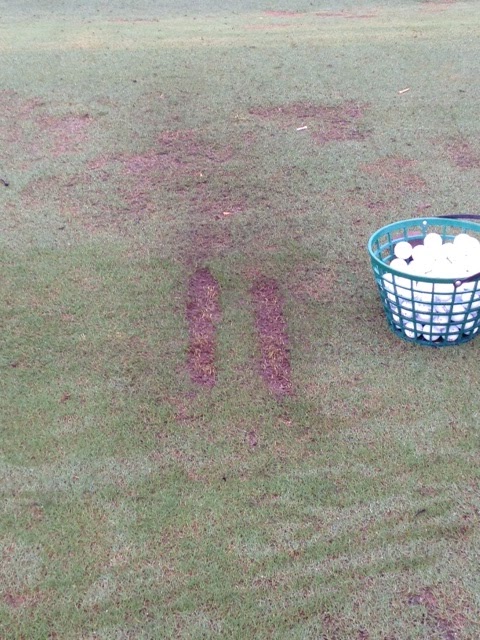
On the morning the range tee opened for use (April 11th) I took the liberty of hitting 20 balls from two adjacent stalls using the above methods and taking photos with my phone.  I used a 6 iron for each shot and primarily focused on taking a divot more so than striking the ball (funny how that seemed to create excellent contact).  Anyway, the results are below:


20 Balls Total
10 Balls Each Strip!


The long strips will heal more quickly as the turf grows in from both sides and I have left more turf for the next person.  The "shotgun blast" depicted on the right leaves less good turf for the next person and more closely resembles someone in need of a lesson.  Give this method a try, it not only will help the turf on the range tee but it may also improve your ball striking!

Before I wrap up I want to mention a few things about the course.  Despite the abnormally cool spring and lack of rainfall the past three weeks (0.59" total the past 21 days) the golf course is in excellent shape for the current conditions.  The fairways are firm and fast with lots of ball roll.  The greens are firm, yet receptive with smoothness and good speed.  The grasses in the natural/native areas are beginning to seed and overall the golf course is slowly waking from a long winter's nap and coming to life.  I know right now the forecast looks bleak for the qualifying tournament this coming Monday but my staff and I are still planning on presenting your golf course in it's best shape possible.  We will be working late Sunday evening with a full mowing scheduled as we prep the golf course for tournament conditions. 

One final note, be mindful of where you drive your golf cars as traffic is one of the biggest deterrents to bermudagrass green-up, growth and development.  If you don't believe me just pay attention next time to areas that were roped off most of the winter compared to others.  Also, please do not park your golf cars near teeing areas unless you are permitted as a flagged rider.  This person is providing an excellent example of something you should not do:

Don't Park Here!

See you on the course,

Matthew Wharton
Golf Course Superintendent

Friday, April 5, 2013

The Rolling Stones, Divot Management and Irish Luck!

Hello and welcome to "The Greenkeeper"! Today is Friday, April 5, 2013 and what a difference a week makes.  This time last week the trees were bare and the course was dormant brown.  Now the trees are either blooming or beginning to produce leaves depending on species and the bermudagrass is beginning to wake from one of the longest winter hibernation periods in decades.  A colleague of mine told me this morning he heard a report this was the 3rd coldest winter on record for our area.  Of course the rapid breaking of dormancy by the bermudagrass this week was assisted thanks to some perfect timing and near perfect conditions.  You may recall during the warm March experienced last year we treated our tees and fairways with Iron Sulfate in order to darken the turf canopy (paint it black).  The darkened surface absorbs the energy from the sun and raises the soil temperatures, which in turn aids the process of bermudagrass green-up (kind of like the effect you feel on your back when wearing a black or navy shirt on a sunny day).  Anyway, the process works best when the turf canopy is wet (the near 0.75" rain that fell over Easter weekend produced the right moisture conditions) and abundant sunshine is available (Monday seemed like the first sunny day in ages). 
 
We sprayed all the fairways this past Monday.  This picture taken on the 5th hole looking back towards the tees shows the effect in the early stages as depicted by the irregular spray pattern along the fairway/rough margin.  The level of darkening has increased each day this week.
 
#5 Fairway
We sprayed all the tees this past Tuesday and again the picture below depicts the effect along the edge of treated vs. untreated.  You can also clearly see a significant amount of green leaf blades in just a short period of time.
 
#5 Back Tee
We received over an inch of rain last night so once again we enter into a weekend with golf car restrictions but the forecasted temperatures for Saturday and Sunday (65 and 71 degrees respectively) along with some sunny skies should continue to produce mass greening of the short cut turf on the course.  These temperatures are also a welcome change for the recovery of our bentgrass putting surfaces.  It has now been 2 1/2 weeks since aeration and the cold conditions kept the grass in check and prevented healing in a timely fashion.  Our mowing this morning was the first where we collected more grass than sand in the buckets so we have turned the corner and I expect rapid healing between now and next weekend!
 
Although the driving range tee appears to be the greenest place on the property when viewed from the back of the clubhouse (it too was treated with iron sulfate this week) up close you can see it needs a little more time before we unleash everyone.  I have discussed the matter with both the Greens Committee and the Golf Professional Staff and we will open the grass tee line on Thursday, April 11th (coincidentally day one of the Masters).  I want to thank everyone for their patience and understanding this year as we have all endured a longer than normal winter for a change.  I also want to take this opportunity to share a photo with you that depicts the proper way to use the range with respect to taking divots.
The Preferred Method!
If we can all utilize the range tee with the divot pattern depicted above we will have the best conditioned range tee in the city!  This method maximizes the use of the entire tee surface and also grows in faster.  So think long, narrow strips!
 
Finally, last time I mentioned I would share more information on the new seasonal staff so I would like to introduce them to you.  These guys come to us from Hidden Creek Contractors, Inc. in Bakersville, NC (the same service provider we have used since 2010). 
Hard Working Lads!

From left to right we have Roman, Anatolie, Viorel, Ion, Paul and Fionnbharr.  Roman, Anatolie, Viorel and Ion are from Moldova while Paul and Finn are from Ireland.  Finn is a very experienced golf course employee having worked for nearly five years at a course back home in his native land.  These guys have been working extremely hard for nearly three weeks and I am most pleased not only with their efforts and work ethic but also their pleasant demeanor and personalities!  Earlier this week they spent close to three days reworking every bunker on the course to ensure proper sand depth, firmness and smoothness to the bunker floors.  I managed to play Wednesday afternoon and unfortunately found myself in multiple greenside and fairway bunkers.  Although this was hazardous (pun intended) to my score it provided the opportunity to test their work and I found the bunkers to be fantastic (firm and smooth with proper depth to play the shot required).  Next week they will be trained to walk mow greens and as the growing season fast approaches so does their responsibilities and duties.  These guys are all far from home but in good spirits so please let them know you appreciate their being here to help me provide you with the best playing conditions in Charlotte!

See you on the course,

Matthew Wharton
Golf Course Superintendent

Thursday, March 21, 2013

March Madness, Turf Nerd and Cinderella!

Hello and welcome to "The Greenkeeper"! Today is Thursday, March 21, 2013 so turn in your brackets and let the madness begin.  With the arrival of spring (the equinox occurred yesterday) and the NCAA basketball tournament that means we just wrapped up our first aeration of the putting greens for the year (traditionally the 3rd Monday in March) and the process was ... a process!  I arrived at the course this past Monday to discover potentially heavy rains were forecasted for later that day.  With the new seasonal staff on hand (more on these guys at a later date) the decision was made to focus only on the aeration and core removal tasks and get as much accomplished as possible (topdressing would be postponed till the following day). 
 
Cores Pushed Into Rows
Aerating the Last Surface!
The staff worked really hard in the cold, damp conditions and we were able to aerate all 22 bentgrass surfaces (1-18, practice green, chipping green, warm-up green and nursery green) and remove all cores on Monday. 
 
Removing the Cores
It started to rain pretty steady as we were wrapping up our last green about 5:30 pm and overall I felt pretty good about what we accomplished.
 
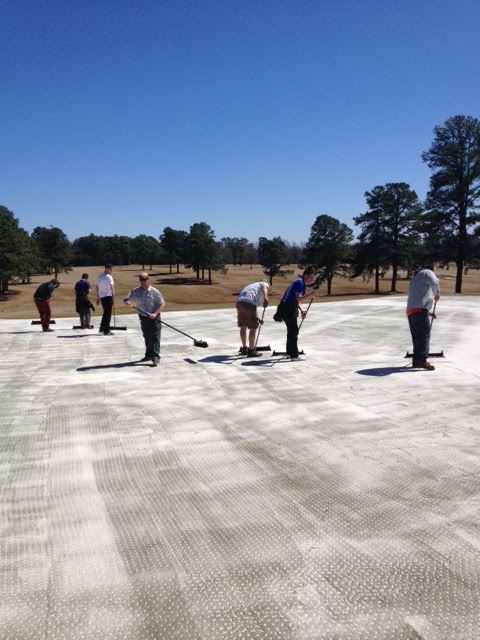
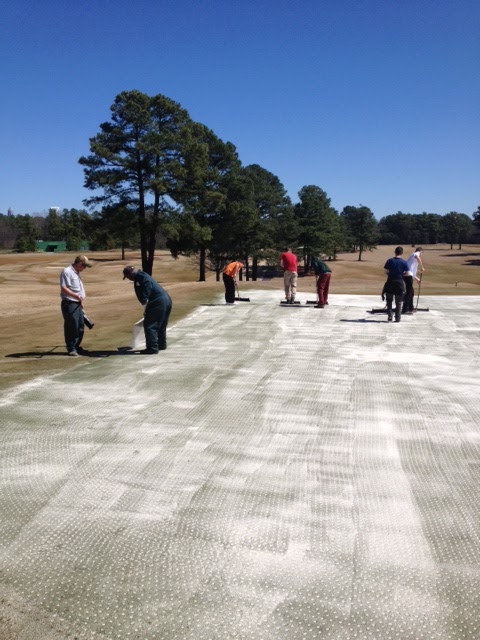
Day 2 started with discovering 0.75" rain in the gauge from the overnight line of storms along with foggy conditions.  In order to topdress with kiln dried sand the surface needs to be dry (this allows the sand to be worked into the holes) and thus we had to wait until the sun finally came out around 9:30 am and the breeze kicked up before conditions were satisfactory for topdressing.  Also, the bright, sunny skies were a welcome change to the cold, grey day before.  Once we were able to topdress the crew worked diligently all day hand brushing the topdressing.  This ancient method ensures all holes are filled completely.
 
Hand Brushing the 5th Green
Ensuring All Holes are Filled
We wrapped up the day around 7:00 pm and still had 14-18, the practice green, chipping green and nursery remaining.  Fortunately we were able to start right away yesterday morning with dry conditions (no morning dew) and completed 14-18 by lunch time and then completed the remaining surfaces before closing the book on this project.  All the greens were fertilized and heavily irrigated to help settle and compact the sand.  
 
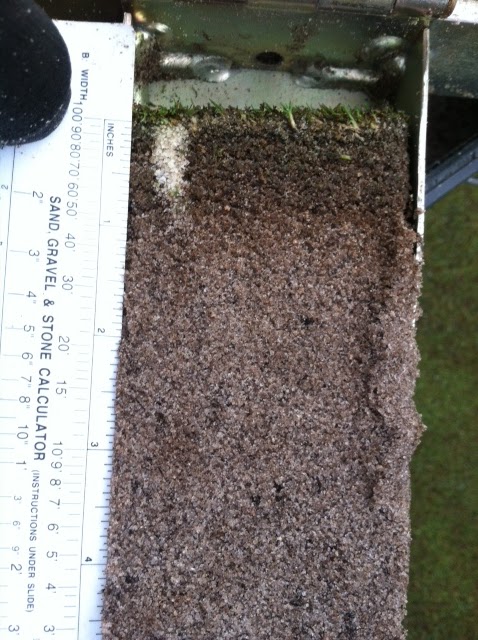
Although the aeration took 3 days (mostly weather related) I am excited about the results it will yield with regards to the performance of our putting surfaces this coming season.  You see, as putting greens age there is a natural accumulation of organic matter in the upper one to three inches of the root zone (as depicted below by the darker region of the upper root zone).  This comes from the natural death and decay of older plant leaves and roots over time and this accumulation if left unchecked can lead to severe problems down the road (poor water infiltration, higher disease incidence, poor gas exchange in the root zone, etc.).  Our greens were established in the spring of 2008 (five years ago) and thus we can no longer treat them as if they are brand new. 
 
Organic Accumulation and Old Aerator Hole
The secret to great bentgrass putting greens in the humid, southeast is core aeration!  You may be able to get by with less core aeration in other parts of the country but multiple core aeration is imperative to the health and survivability of bentgrass in our region.  My goal was to have the greatest impact to the putting greens while simultaneously minimizing the total surface disruption.  The USGA Green Section recommends core aeration impact 20% of the total surface area annually.  I selected a tine that would impact as close to 10% of the surface area as possible (remember we repeat this process annually each September).  Add our pencil tine aeration in late May/early June and you get 20% thus we are on target.  The sand will smooth and firm the surface, dilute the thatch and organic matter and create channels in the aeration holes which will promote greater water infiltration and allow oxygen deeper into the root zone!  In other words, our aeration process will make our great greens even greater!
 
So far this has been one of the longest and coldest winters I can remember.  Okay, maybe not the coldest as far as extreme cold temperatures are concerned but coldest in the sense that temperatures have been below normal for many more days than not.  I blame Cinderella! 
 
Not This Cinderella
This Cinderella

March, 2012 saw 10 days of 80 degrees or more and the two days of greens aeration last year were 83 and 82 degrees respectively with morning lows of 55 and 59 degrees.  This year we have had zero days of 80 degrees or more thus far and the two scheduled days of aeration we experienced high temperatures of 46 and 66 degrees respectively with morning lows of 40 and 39 degrees.  This morning it was back down below freezing (I swear I believe Mother Nature has run off with Old Man Winter).  Anyway, this time last year the bermudagrass was greening up and the greens were growing rapidly which assisted in their recovery from aeration.  Although I am thrilled with the results of the putting green aeration I am disappointed the weather is unseasonable (according to WCNC's meteorologist Brad Panovich the temperatures will most likely remain well below normal until sometime after Easter which is still over one week away) and this will directly impact how quickly the greens grow and recover from the aeration.  As my good friend Charlie Brown would say...Good Grief!
 
Old Man Winter
Mother Nature
Another unfortunate aspect of this continuation of winter is the impact on the bermudagrass turf.  Although we have not reached 80 degrees yet this year last weekend did see high temperatures of 79 and 77 degrees respectively.  This warm weekend was enough to kick-start the bermudagrass wake-up period and many southern facing slopes on the course are starting to green-up.  This will be short lived with temperatures tonight expected to drop into the upper twenties.  Expect the bermudagrass to hit the snooze button!
 
Believe me when I tell you my staff and I are ready for warmer weather, green grass and more golfers.  It is time for the long cold winter to give way to spring blooms and robins nesting.  We are ready to trade cabin fever for spring fever so hopefully March Madness will usher in a glorious start to the 2013 golf season at Carolina! 
 
See you on the course,
 
Matthew Wharton
Golf Course Superintendent

Friday, March 1, 2013

Education Month, It's Never Easy and Visiting Hours!

Hello and welcome to "The Greenkeeper"! Today is Friday, March 1, 2013...where does the time go?!  Many years ago my grandfather told me you can never have too much education!  Considering his only two daughters were both school teachers (Mom is now retired but my Aunt still teaches) I guess the desire to learn and instruct runs in the family.  The staff and I spent a good deal of time last month attending numerous continuing education seminars.  I started everything off when I attended the GCSAA Education Conference & Golf Industry Show in San Diego February 4-8.  In addition to the normal eduaction sessions available I attended two specialized seminars.  One was called Greens Aerification and Water Management by the Numbers and the other Management of Fine Fescues for "Native" Rough Areas of Golf Courses.  Both classes were very informative and I learned some things we can apply to Carolina to make our current putting green management even better and also improve the performance of our natural/native areas. 
 
On February 20th I sent one of my assistants to Golf Irrigation Service School sponsored by Toro and their local distributor Smith Turf & Irrigation.  The one day seminar instructs attendees on electrical and controller troubleshooting, wiring and grounding issues, radio communications, central control system overview and hands-on sprinkler repairs.  They also provide an open discussion for any specific repair and troubleshooting issues that you may be experiencing on your own course.  This one day course is a great refresher and at least one member of my management staff has attended this seminar the past four years.  On February 21st the North-South Turfgrass Association sponsored a Carolinas GCSA Regional Seminar at Myers Park C.C.  Both assistants attended the two half-day seminars.  In the morning Dr. Dara Park from Clemson University lectured about the different effects poor quality water can have on turf and the turf environment when used for irrigation in her seminar Irrigation Water Quality.  I do test our irrigation water periodically and we immediately collected a sample for testing the next day.  In the afternoon they heard Dr. Bert McCarty from Clemson University give his presentation Managing Bermudagrass Golf Courses and Greens.  I asked them to attend this session as an opportunity to gather information with regards to bermudagrass putting green management.  This does not mean Carolina is converting or thinking about converting.  However, with many courses in North Carolina converting their bentgrass putting greens to the newer hybrid ultradwarf bermudgrasses it is important to stay abreast of current industry trends.
 
Superintendents and assistants aren't the only people who get to have all the fun going to school.  Equipment Manager JR Bailey just wrapped up two days of classes and seminars sponsored by Toro
JR Bailey
and Smith Turf & Irrigation.  On February 27th he attended Hydraulic/Electric Troubleshooting where he received a comprehensive review and evaluation of hydraulic and electrical systems and components commonly found in outdoor power equipment.  They discussed and demonstrated effective techniques, component identification, evaluation and testing.  The next day was Greensmasters where the new Greensmaster 3300 series and Flex 2100 mowers were on display (we use the Flex 2100 mowers to walk mow greens at Carolina and the 3300 series to mow tees and approaches).  Attendees got dirty as they went through maintenance, adjustment and test procedures of both units as well as their dual point adjustment cutting units.  I truly appreciate the opportunity to continue education and training not only for myself but my staff.  Our industry is constantly adapting and evolving and it is important to take the time to learn in order to not fall behind.
 
If you skipped down to this paragraph thinking you were missing the weather update, sorry.  February wrapped up with 3.63 inches total rain and we have received 12.23 inches precipitation over the past three months (note, the first three weeks of December were very dry thus that three month total is really within the past 10 weeks).  All of this rain has led to elevated ground water levels and saturated soil conditions.  This means it takes only a small amount of rain to puddle on the surface and create unplayable conditions.  Especially during the winter months when dormant turf and dormant trees are not taking up water and lower temperatures, shorter days and low sun angles greatly reduce evaporation rates.  This makes for a very challenging situation as we are trying to treat the golf course with preemergent herbicide.  Every year at this time we treat the bermudgrass (tees, fairways and roughs) with Ronstar, a preemergent herbicide to prevent crabgrass and goosegrass from invading our playing surfaces during the spring and summer.  The product is sprayed onto the leaf surfaces and then either irrigation or natural rainfall washes the chemical compound off the turf canopy and moves the product down below the thatch into the upper portion of the soil.  Here the chemical compound adheres to the soil and forms a barrier that prevents crabgrass and goosegrass from successfully germinating and establishing.  Our challenge is both getting the course to dry out enough to tolerate the traffic from the sprayer and apply the herbicide accurately without it being washed away as opposed to watered in considering the current state of our saturated soils.  Fortunately the cold weather is keeping soil temperatures lower than normal for this time of year so we still have a few more weeks before we have to play beat the clock.
 
This morning I witnessed some deer hoof prints on the 13th fairway.  I saw some tracks on the 10th hole a few days ago so I guess we have some visitors wandering around at night.  I actually saw two
Deer Tracks!
deer near my shop one weekend morning last month but was unable to capture their picture.  It never ceases to amaze me what a diverse population of wildlife we have on the golf course considering our urban location.
 
 
See you on the course,
 
 
Matthew Wharton
Golf Course Superintendent